

You need finance help. You post a job for a "Finance Manager." You get 200 applicants—CFOs, Controllers, FP&A analysts, bookkeepers, and people who just like spreadsheets.
Which one do you hire?
Hiring the wrong finance leader is one of the most expensive mistakes a founder can make. A CFO at the wrong stage is bored and leaves. A Controller when you need strategy leaves you without direction. An FP&A hire without accounting support leaves you with great forecasts and messy books.
This guide breaks down the exact differences, when to hire each, and what they should cost.
The Finance Role Landscape in 2025
Finance roles have become more specialized. Ten years ago, one "finance director" did everything. Today, companies hire distinct roles for distinct needs.
Key trends:
60% of companies now separate accounting (backward-looking) from FP&A (forward-looking)
Fractional roles account for 35% of finance leadership placements
The "hybrid" finance hire (does everything) is disappearing at companies above $5M ARR
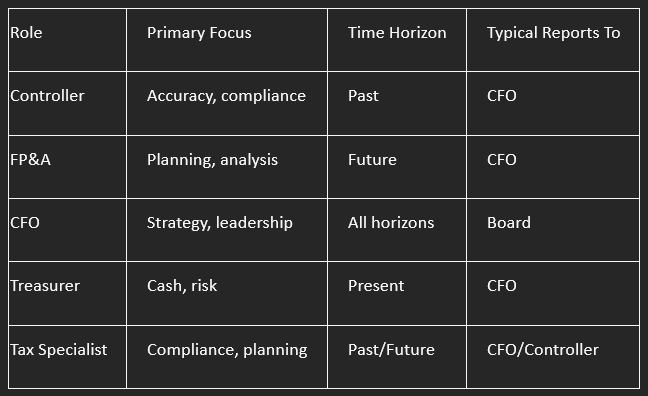
The 10 Critical Differences
Difference #1: What They Care About
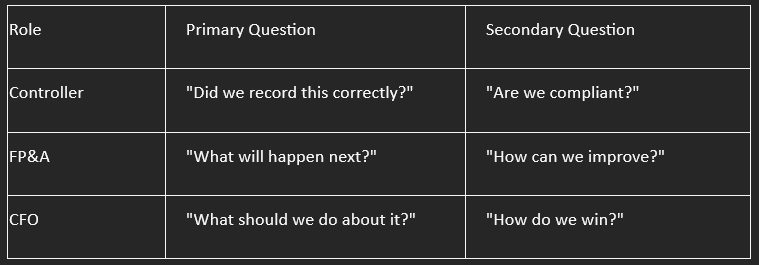
Example: Revenue is down 10% this month.
Controller: "Let me verify the numbers are correct and reconcile any discrepancies."
FP&A: "Let me analyze which segments drove the decline and forecast next month."
CFO: "Let me decide whether to cut costs, adjust pricing, or accelerate sales hiring."
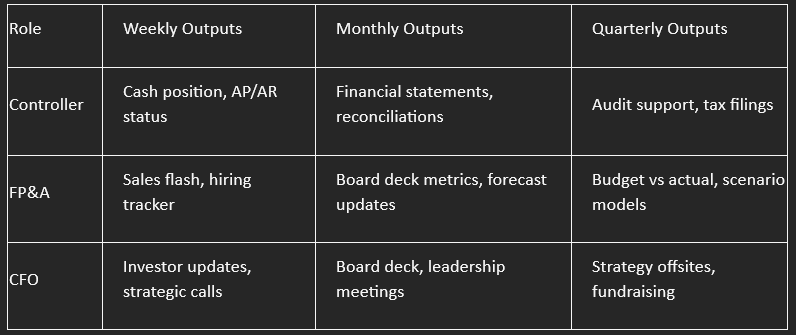
Difference #2: Typical Outputs
Difference #3: Systems They Use
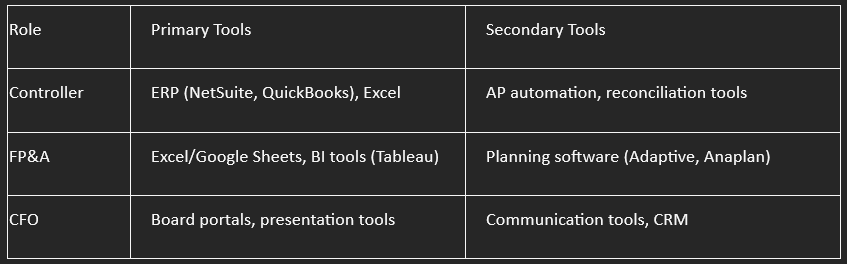
The overlap: All three use Excel. But they use it for different things. Controllers use it for reconciliations. FP&A uses it for models. CFOs use it for board presentations.
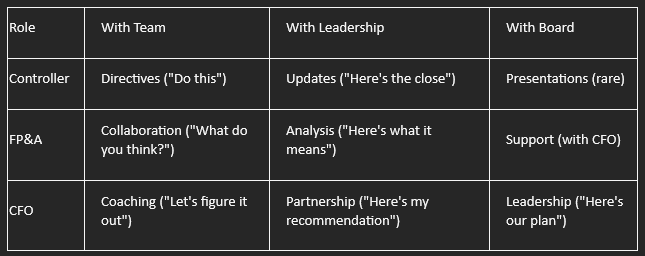
Difference #4: Interaction Style
Difference #5: Typical Background
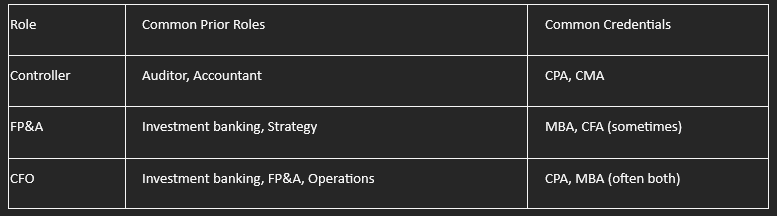
The path: Most CFOs come from FP&A or investment banking, not from Controller roles. Controllers focus on accuracy; CFOs focus on strategy. Different mindsets.
Difference #6: When to Hire First
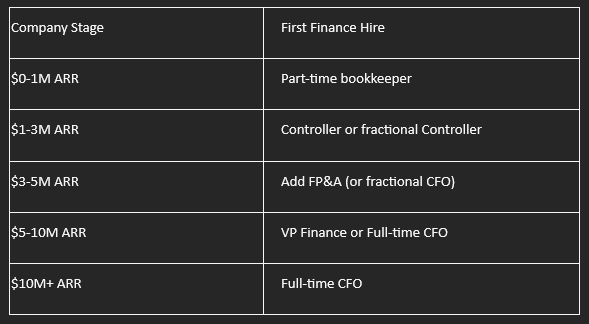
The mistake: Hiring a CFO at $3M ARR. They're bored. They leave. You've wasted $200K.
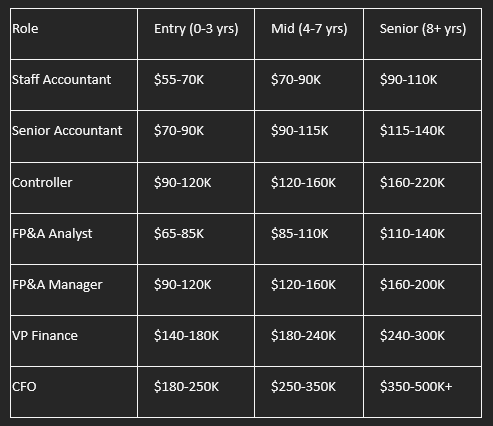
Difference #7: Cost by Role (2025 Data)
US Salary Bands:
MENA Salary Bands (USD equivalent):
Source: Robert Half Salary Guide 2025, MENA Finance Talent Report 2025
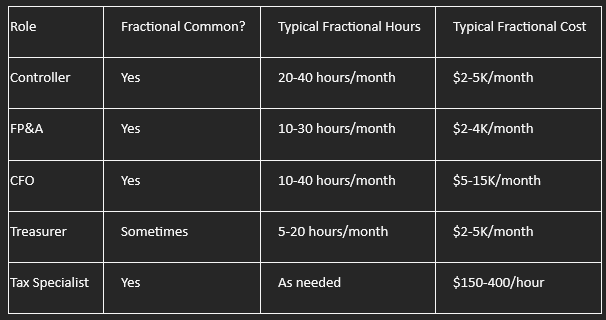
Difference #8: Fractional Availability
Difference #9: Reporting Structure
$1-5M ARR:
├── CEO
├── Controller (or fractional)
$5-15M ARR:
├── CEO
├── VP Finance (or fractional CFO)
├── Controller
├── FP&A Analyst
$15M+ ARR:
├── CEO
├── CFO
├── Controller (with accounting team)
├── FP&A Manager (with analysts)
├── Treasury (emerging)
Difference #10: Signs You Have the Wrong Person
You hired a Controller but need strategy:
They ask "How should I record this?" instead of "What does this mean?"
They're uncomfortable with uncertainty
Board meetings are just data dumps
You hired an FP&A but need accounting:
Great forecasts based on wrong data
Models are beautiful, books are messy
Month-end close takes 3 weeks
You hired a CFO too early:
They're bored by day-to-day work
They spend more time with board than team
They're pushing for complexity you don't need
Real-World Case Study: The $3M CFO Mistake
Company: B2B SaaS, $3M ARR, 25 employees
The mistake: Hired a full-time CFO at $250K + 2% equity.
What happened:
CFO was bored within 3 months (not enough complexity)
Started creating work to stay busy (over-engineered systems)
Team frustrated with new processes
CFO left after 11 months
The cost:
Salary paid: $230K
Recruitment fees: $50K
Lost productivity: $100K+
Equity given: 2% (worth $400K at next round)
Total cost: ~$780K
What they should have done: Hired a fractional CFO ($8K/month) and a Controller ($120K/year). Same expertise, half the cost, better fit.
Step-by-Step: Choosing Your First Finance Hire
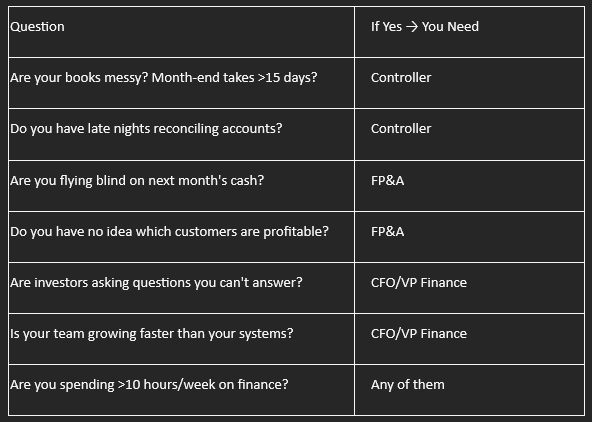
Step 1: Diagnose Your Biggest Problem
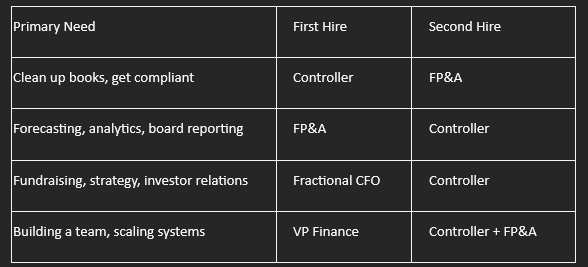
Step 2: Match Need to Role
Step 3: Decide Full-Time vs Fractional
Choose fractional if:
Your need is <30 hours/week
You're pre-Series A
You want expertise without commitment
You're testing the role
Choose full-time if:
Your need is >40 hours/week
You're post-Series A
You need someone embedded in the team
You're ready to build a department
Step 4: Write the Job Description
Controller Job Description Template:
Title: Controller
Reports to: CEO / VP Finance
About the role:
We're a [stage] SaaS company looking for our first Controller. You'll own the month-end close, financial reporting, and accounting operations. You'll work closely with the leadership team to ensure accurate, timely financials.
Key responsibilities:
1. Own the monthly close process (complete by day 10)
2. Prepare monthly financial statements with variance analysis
3. Manage AP/AR and cash application
4. Coordinate with external auditors and tax preparers
5. Implement and maintain accounting policies and systems
You have:
- CPA or equivalent (required)
- 5+ years accounting experience
- SaaS industry experience
- NetSuite or similar ERP expertise
- Big 4 background (nice to have)
You are:
- Detail-oriented but can see the big picture
- Comfortable with ambiguity
- A communicator (finance to non-finance)
Compensation: $120-150K + equity
FP&A Analyst Job Description Template:
Title: FP&A Analyst
Reports to: CEO / VP Finance
About the role:
We're looking for our first FP&A Analyst. You'll own financial planning, forecasting, and analysis. You'll help the leadership team make better decisions through data.
Key responsibilities:
1. Build and maintain financial models (P&L, cash flow, scenarios)
2. Prepare board reporting packages
3. Analyze unit economics by product/channel/segment
4. Support fundraising with investor materials
5. Partner with department heads on budgets and forecasts
You have:
- 3+ years in FP&A, investment banking, or consulting
- Advanced Excel/Google Sheets skills
- Experience with SaaS metrics
- Strong communication skills
You are:
- Curious (you ask "why" not just "what")
- Comfortable with uncertainty
- A storyteller with numbers
Compensation: $90-130K + equity
Step 5: Interview for Fit, Not Just Skills
Questions to ask all candidates:
"Walk me through a time you made a mistake. What happened and what did you learn?"
"How do you explain complex finance concepts to non-finance people?"
"What's your experience with companies at our stage?"
"What systems have you implemented and why?"
"How do you handle competing priorities?"
Role-specific questions:
For Controllers:
"Walk me through your ideal month-end close process."
"How do you ensure accuracy without slowing things down?"
"Tell me about a time you found a material error. What happened?"
For FP&A:
"Build me a simple SaaS model structure on this whiteboard."
"How do you forecast when there's limited historical data?"
"Tell me about a time your analysis changed a company decision."
For CFO candidates:
"What's your fundraising philosophy?"
"How do you think about balancing growth vs profitability?"
"Tell me about a time you had to deliver bad news to the board."
5 Biggest Hiring Mistakes
Mistake #1: Hiring a CFO When You Need a Controller
A CFO at $3M ARR is like hiring a 5-star chef to make sandwiches. Overqualified, overpriced, and probably bored.
The fix: Be honest about your needs. If your books are messy, you need a Controller. If you need strategy, you need a CFO. Rarely both at the same time.
Mistake #2: Expecting One Person to Do Everything
You want someone who can close the books, build models, raise money, and manage a team. That person doesn't exist. And if they did, they'd cost $500K.
The fix: Specialize. Hire a Controller for accounting. Hire an FP&A for analysis. Hire a CFO for strategy. Or use fractional for some roles.
Mistake #3: Ignoring Communication Skills
The best financial mind is useless if they can't explain things to the team. Finance touches every department. Communication is not optional.
The fix: In interviews, ask them to explain a complex concept simply. Have them present to a non-finance person. Watch how they adapt.
Mistake #4: Underpaying Critical Roles
You try to save $20K on a Controller and end up with someone who can't handle the complexity. Errors cost you $100K+.
The fix: Pay market rate for must-have skills. Save on junior roles, not senior ones.
Mistake #5: No Clear Success Metrics
The hire starts. No one knows what success looks like. Three months later, everyone's frustrated.
The fix: Define 90-day success metrics before they start. Write them down. Review them together.
Expert Predictions for 2026-2028
Prediction #1: Continued specialization
The "generalist" finance hire will disappear at companies above $10M ARR. Companies will hire distinct Controller, FP&A, and Treasury roles.
Prediction #2: Fractional for mid-market
Even $20-50M companies will use fractional specialists for tax, treasury, and M&A rather than hiring full-time.
Prediction #3: CFOs with operating experience
Boards will increasingly demand CFOs with P&L ownership, not just finance background.
Prediction #4: FP&A becomes strategic partner
FP&A roles will evolve from "budgeting and forecasting" to "strategic business partner" working closely with each department.
Frequently Asked Questions
Q1: Can one person be both Controller and FP&A?
At very early stages ($1-3M ARR), sometimes. But it's hard. The mindsets are different (accuracy vs analysis). By $5M ARR, they should be separate roles or you'll compromise both.
Q2: Should my first finance hire be a Controller or FP&A?
If your books are messy, hire a Controller first. If your books are clean but you're flying blind, hire FP&A first. Most companies need Controller first because clean books are the foundation.
Q3: What's the difference between a Controller and a VP Finance?
A Controller focuses on accounting accuracy and compliance. A VP Finance focuses on strategy, planning, and team building. The VP Finance usually manages the Controller at larger companies.
Q4: When do I need a full-time CFO?
Typical triggers: Revenue above $8-10M ARR, team above 50 employees, post-Series B, or when finance work exceeds 40 hours/week. Before that, fractional works.
Q5: How do I know if my Controller can become a CFO?
Most Controllers don't make good CFOs. Different skills. Ask: Do they think strategically? Are they comfortable with uncertainty? Can they communicate vision? If yes, they might have CFO potential. If no, hire externally when you're ready.
Conclusion
Hiring finance talent isn't about finding the smartest person. It's about finding the right person for your stage and needs.
A Controller at $3M is a hero. A CFO at $3M is a liability. An FP&A hire at $5M is a game-changer. The same person at $15M might be perfect or completely wrong.
Know what you need. Hire for that. And when your needs change, be ready to adapt.
Ready to find your next finance hire? Fintant connects startups with vetted finance talent at every level—from fractional Controllers to full-time CFOs. Tell us your stage and needs, and we'll match you with candidates who've done it before.